
LEONARDO RINALDI
 1
1
 2
2
 3
3
 4
4
The publication is of high complexity in terms of execution and handling; the creation of this graphic design was also quite complicated, as it required a high level of attention due to the quantity of tabulations, tables and charts, whilst the text section had a simple diagramming layout.
The periodic presents information from various sources, compiling data that has selected from the IBGE, the Getúlio Vargas Foundation, Conjuntura Econômica (formerly the CNC’s weekly journal), the Foreign Trade Secretariat (Secex), Petrobras, the Central Bank of Brazil, the Brazilian Iron and Steel Institute (IBS), the Brazilian Association of Motor Vehicle Manufacturers (Anfavea), the Brazilian Association of Shopping Centres (Abrasce), Embratur, the Brazilian Franchising Association, etc. The technical team, in collaboration with me, has requested that statistical data to be interspersed, in tabular format, with graphs and the authors’ analyses, it has been aiming to create greater visual and informational appeal that would lend more consistency to the content, making it explanatory and contextualised for the reader.
Process and concept:
Despite the need for aesthetic improvement, it was essential not to disrupt abruptly from previous versions; therefore, I have been following the research and the analysis of the old project, to adopt a more institutional approach, I have sought to follow a direction aligned with this path, a decision taken jointly with the technical group led by the Economic Adviser to the CNC and Coordinator of the CNC Technical Council2, Ernane Galvêas (former Minister of Finance of Brazil (1980–1985) and former President of the Central Bank of Brazil (1968–1974 and 1979–1980) (IN MEMORIAM)).
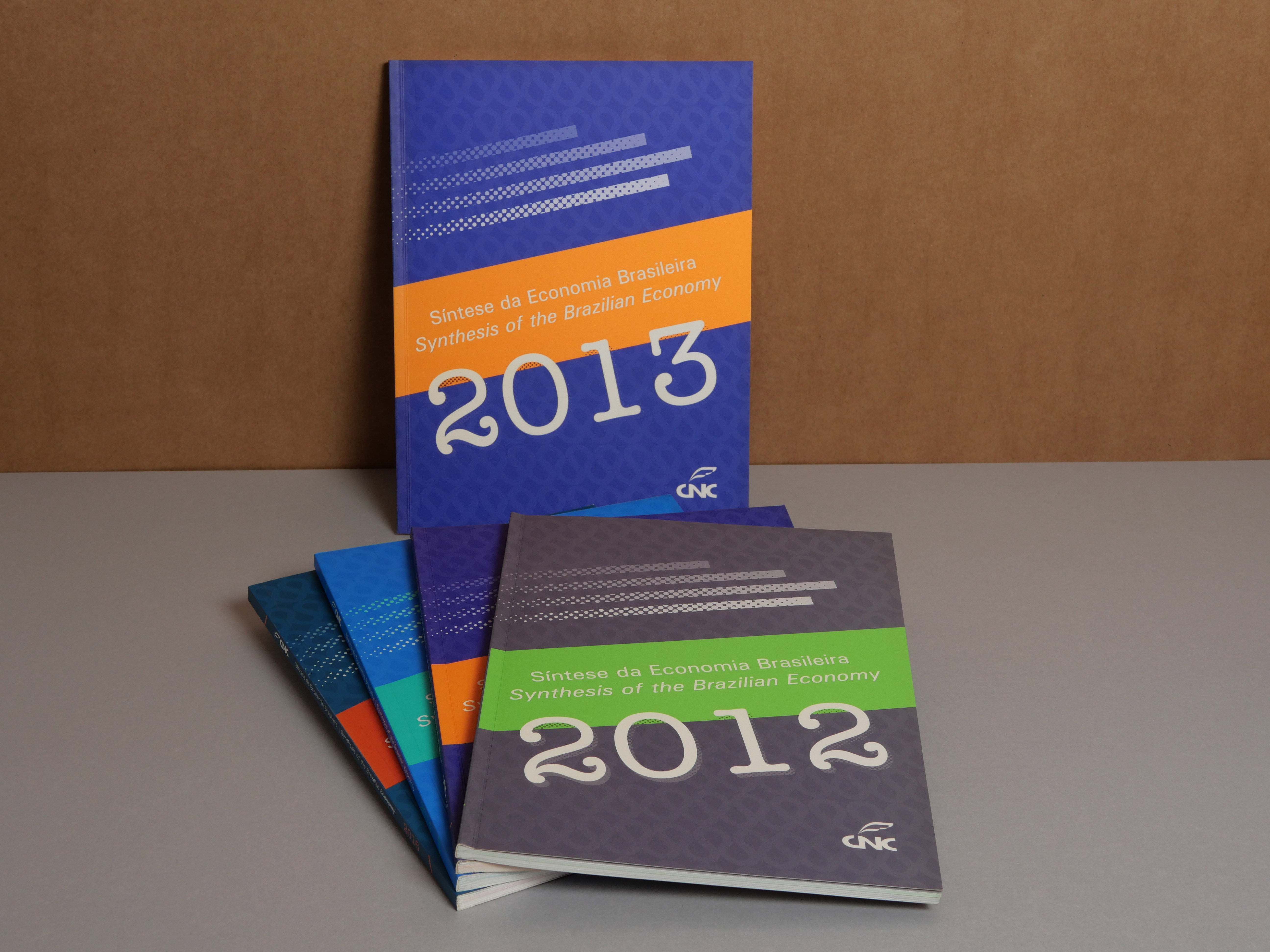
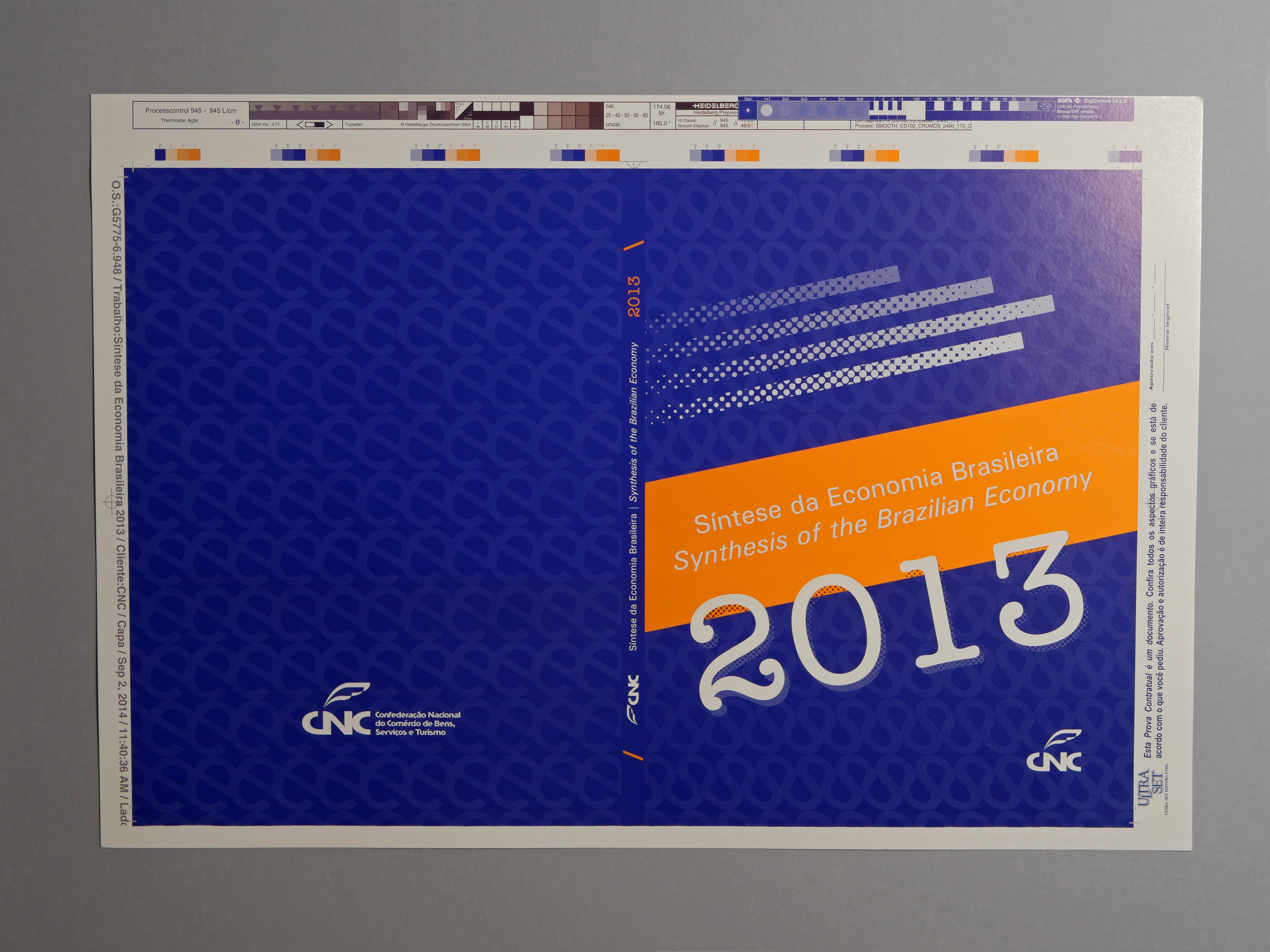
On the covers, I have included a background graphic featuring the letter ‘s’ (for ‘Síntese’) in a mesh pattern. At the top of the cover, another graphic symbolises a comparative chart of Brazil’s Gross Domestic Product (GDP) over the last four years, creating a more institutional layout, this serves merely as an illustration, but shows the appropriate year-on-year variations. At the bottom, with greater prominence, appears the year of the analysis, together with the title of the publication, the visual appeal has ended up being relegated to the core of the publication, with the tables, tabulations, and graphs.
In organising the main body, I have followed the hierarchy of information, prioritising it in the following order:
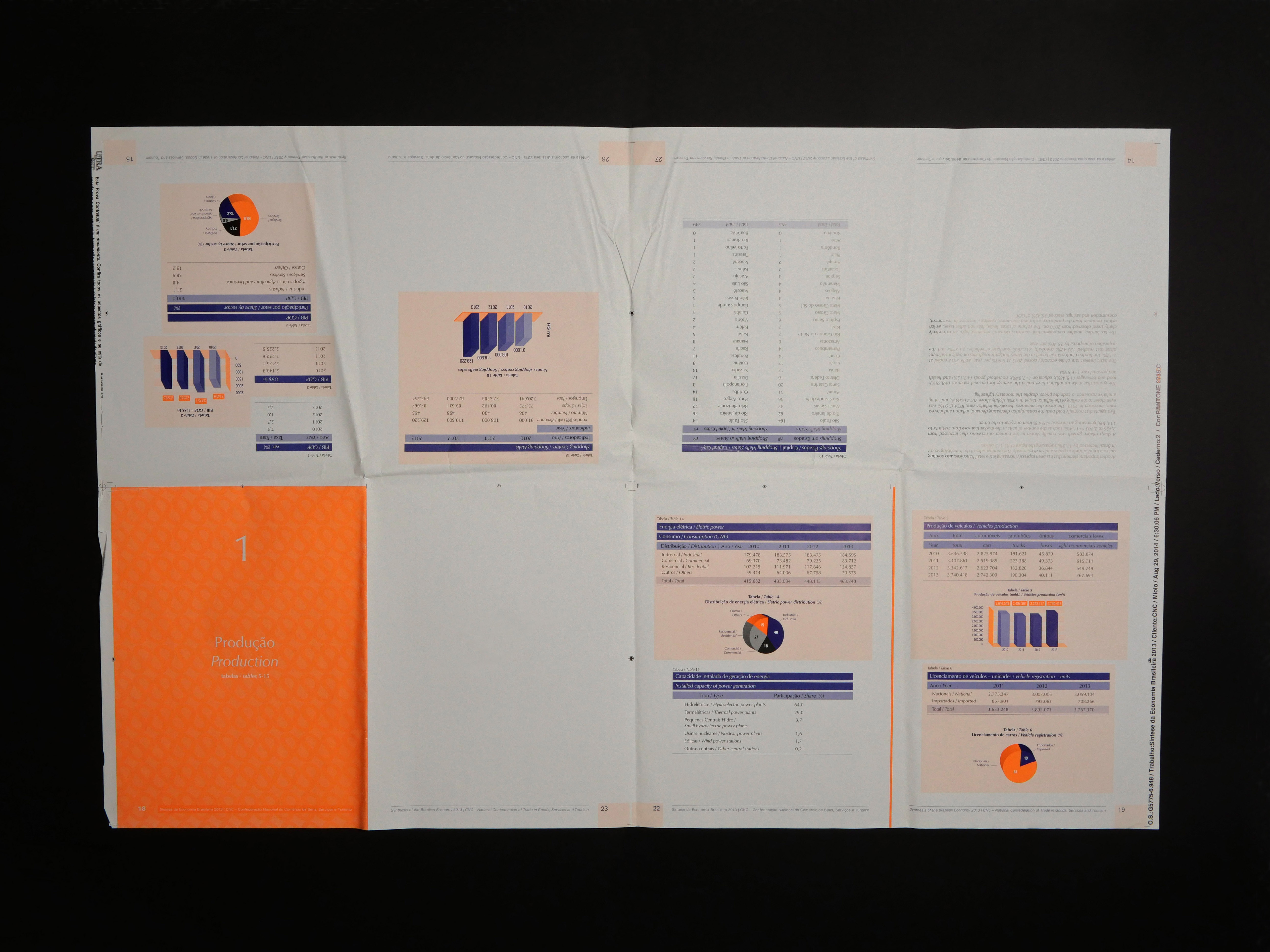
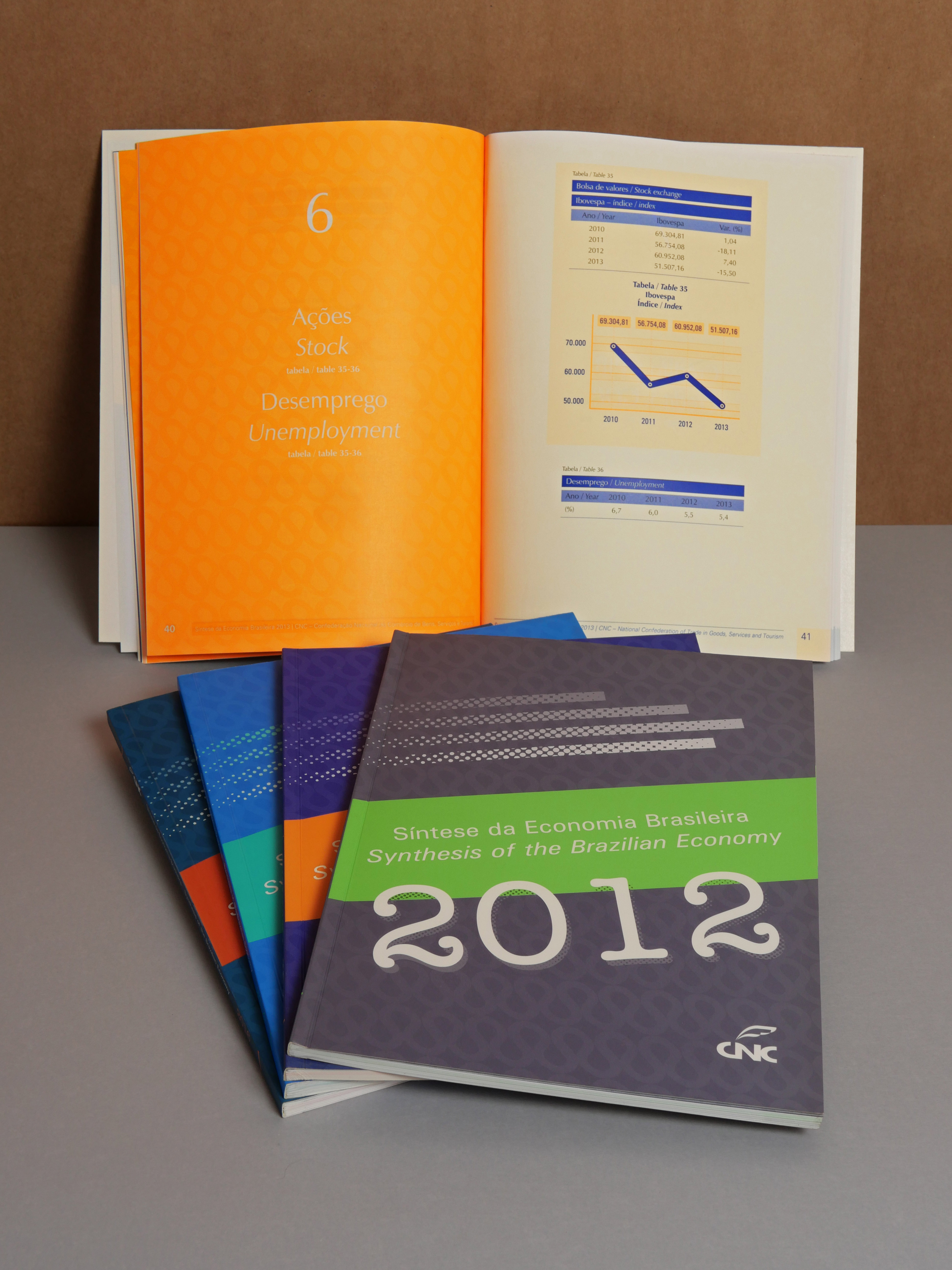
From there, I have developed a design concept for the publication, where the main focus was on the tables, aligning them in such a way as to always highlight the data and enable the reader to make the necessary comparisons, standardising the publication in an institutionalised manner whilst presenting it in an attractive, non-tedious way.
Colours – The project has been adopted a dual approach, contrasting two Pantone colours (which vary with each edition). One Pantone colour is more opaque and the other translucent throughout the entire edition (cover and interior, and in the interior much like a highlighter), to create a layering of colours where one counterbalances the other in various situations throughout the book. Black was also used throughout the text, serving as an additional colour in the graphics. The aim was always to rely on one dark Pantone colour and one light Pantone colour, so that the latter acts as a supporting element in the layout of each page.
1 National Confederation of Trade in Goods, Services and Tourism (CNC – cnc.org.br) – An employers’ trade union organisation, bringing together 34 federations across Brazil, 27 representing their respective states and 7 of these 34 operating at national level, representing over five million businesses in the trade sector that generate around 25.5 million direct and formal jobs. Through its structure, it works to ensure the sector is always involved in the formulation of public policy, monitoring the progress of relevant proposals in the National Congress and defending the Constitution, always keeping in mind the laws that may impact the sector.
The CNC was founded on 4 September 1945; its president is responsible for the administration of two institutions with significant operations in Brazil, which form one of the largest social development systems in the world: the Social Service of Commerce (SESC – sesc.com.br) and the National Commercial Apprenticeship Service (SENAC – senac.br), the former, with social projects such as Mesa Brasil, the Ecos Sustainability Programme, etc. (operating in the following areas: Food, Social Assistance, Culture, Education, Sport, Leisure, Health, Sustainability, etc.), and the latter in supporting the training and upskilling of employees in the commercial sector (shopkeepers, waiters, chefs, hospitality staff, etc.).
2 CNC Technical Council – A group in which various men and women who have distinguished themselves in their respective fields gave lectures, which were later published as articles; these include diplomats, judges, lawyers, economists, philosophers, etc., among them the Coordinator of the CNC Technical Council and Economic Adviser to the CNC, Ernane Galvêas (former Minister of Finance of Brazil (1980–1985) and former President of the Central Bank of Brazil (1968–1974 and 1979–1980) (IN MEMORIAM)), José Bernardo Cabral (Rapporteur of the 1988 Brazilian Constituent Assembly, former Minister of Justice and former Senator of the Republic), Carlos Tadeu de Freitas Gomes (former Director of the Central Bank), Cid Heraclito de Queiroz (former Attorney-General of the National Treasury from 1979 to 1991), Ives Gandra da Silva Martins (Professor Emeritus at Mackenzie University, UNIP, UNIFEO, UNIFMU, CIEE/O Estado de São Paulo, the Army Command and General Staff Schools (ECEME), the War College (ESG) and the Federal Regional Court of the 1st Region; Honorary Professor at Austral University (Argentina), San Martín de Porres University (Peru) and Vasili Goldis University (Romania); Honorary Doctorate from the Universities of Craiova (Romania) and the PUCs of Paraná and Rio Grande do Sul, and Full Professor at the University of Minho (Portugal); Chairman of the Higher Council of Law at FECOMÉRCIO-SP; Former President of the São Paulo Academy of Letters (APL) and the São Paulo Lawyers’ Institute (IASP), Arnaldo Niskier (Member of the Brazilian Academy of Letters and former President of CIEE/RJ), Vasco Mariz (historian and diplomat, former Brazilian Ambassador to Ecuador, Israel, Cyprus, Peru and Germany), Nelson Mello e Souza (philosopher, former Vice-Chancellor of Estácio de Sá University and member of the Brazilian Academy of Philosophy), Samuel Buzaglo (lawyer, former Deputy Attorney General of the Republic), João Paulo de Almeida Magalhães (economist and researcher at the Centre for Development Studies at CORECON/RJ), Arnaldo Wald (lawyer and Full Professor at UERJ), Marcus Faver (Appellate Judge, former President of the Rio de Janeiro Court of Justice), Claudio Contador (economist, Executive Director of SILCON), Mary Del Priore (historian and writer, member of the São Paulo Academy of Letters), João Ricardo Moderno (journalist), Roberto Fendt (economist, former Special Secretary for Foreign Trade at the Ministry of Economy, Executive Secretary of the Brazil-China Business Council), Maria Beltrão (archaeologist, scientist and researcher, former professor at UERJ, former Director of External Relations at IHGB), Gilberto Paim (journalist) etc.