Summary:
Graphic design for a book – Creation, concept and execution of the entire project, illustrations, cover and monitoring of the printing process.
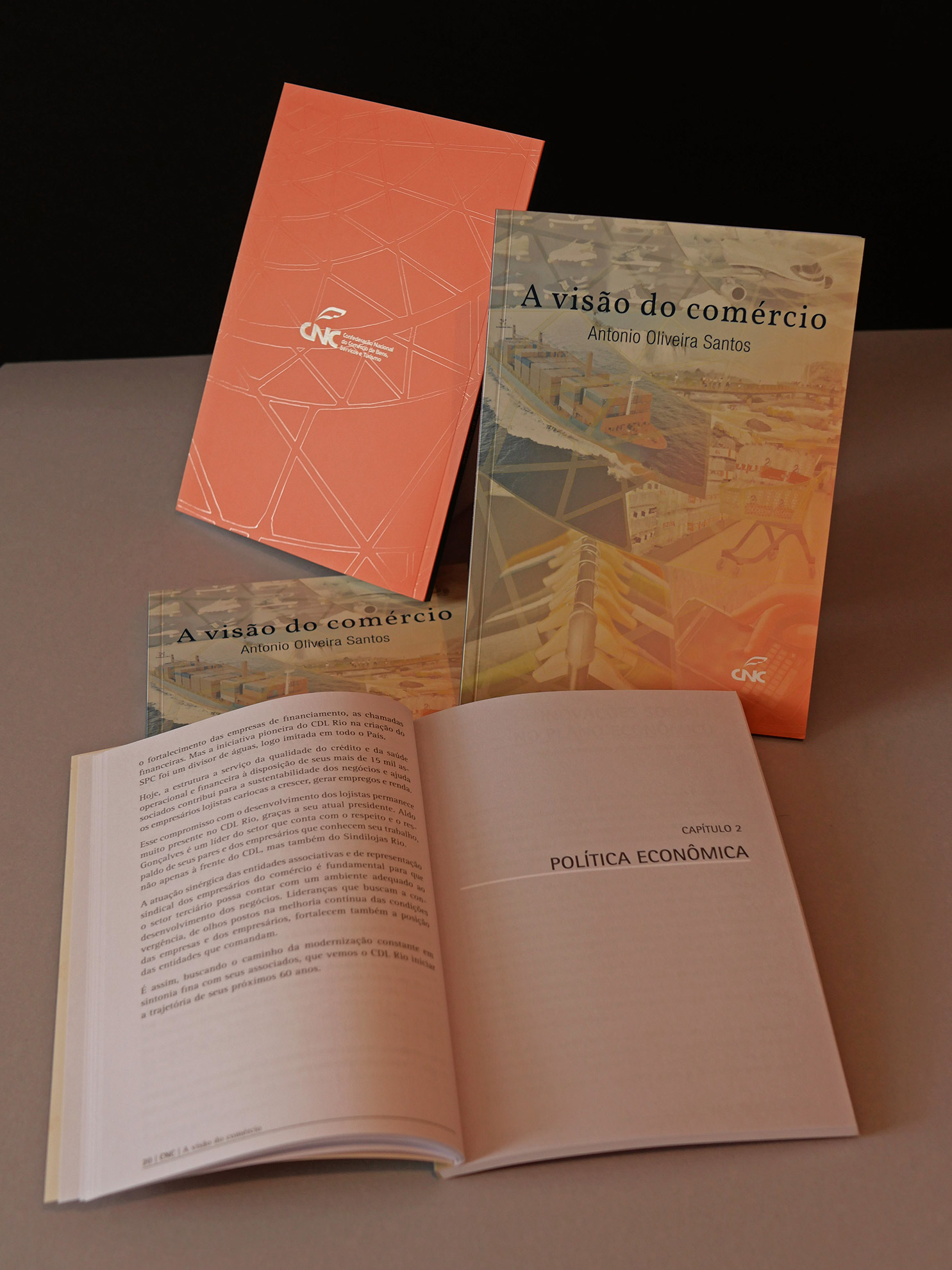
The publication compiling articles by the President of the National Confederation of Commerce (CNC)1, Antonio Oliveira Santos, throughout the year.
Process and concept:
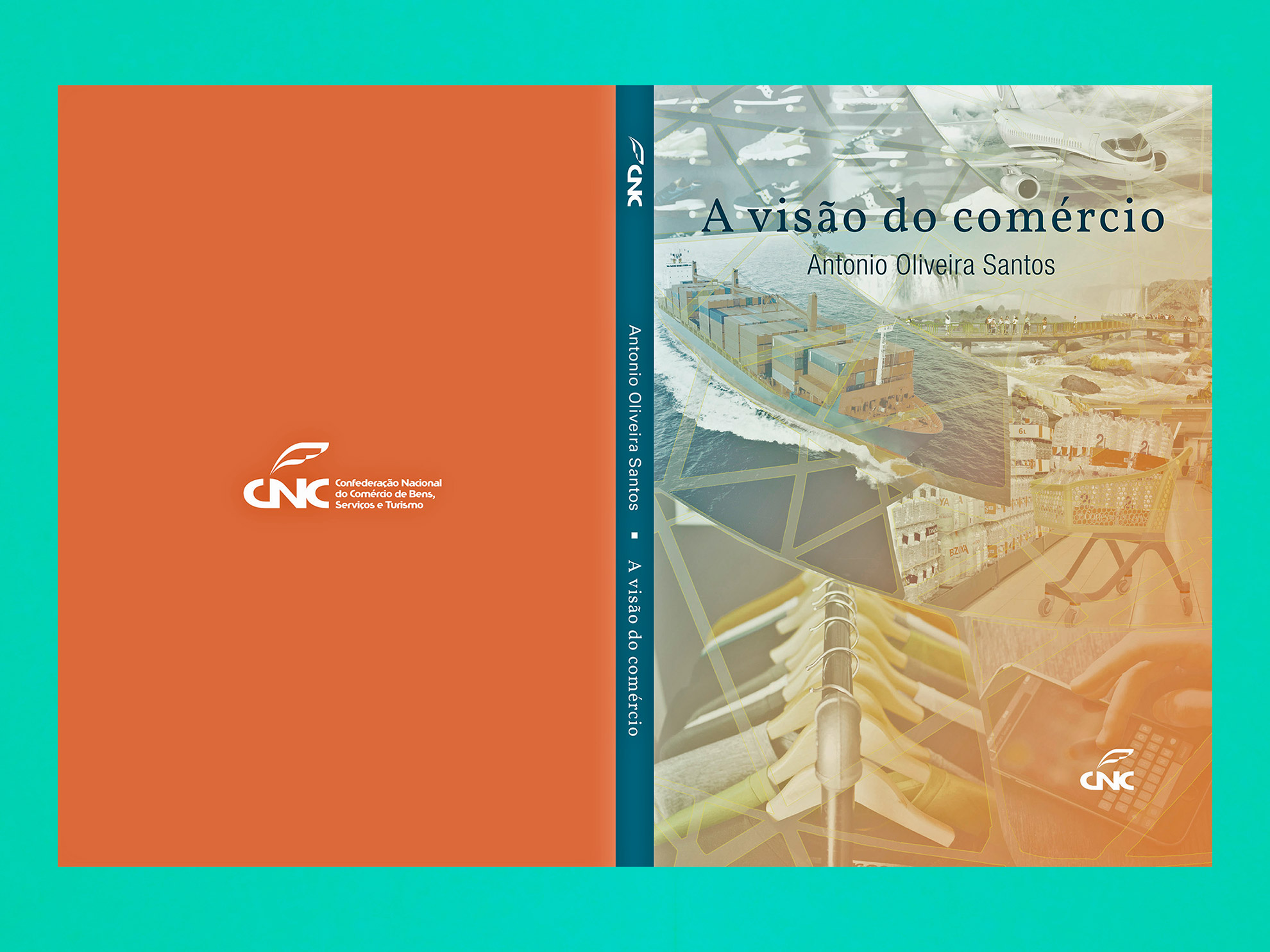
I had received the articles from the CNC Presidency with the title already set for the publication, “The vision of the commerce”. This was a project in which the designer had no direct contact with the client, which is why it tends to be a little more complicated; I did not have the same professional contact that I would have a year later with the coordinator of this book project, the CNC’s Economic Adviser, Ernane Galvêas (former Minister of Finance of Brazil (1980–1985) and former President of the Central Bank of Brazil (1968–1974 and 1979–1980) (IN MEMORIAM)). Consequently, I have developed a line of reasoning based on what I believed the entity and its President wanted as an image for the institution. “Progress” is a word with very strong connotations in the Brazilian business world; not for nothing is it written on the country’s flag2. The aim has been to create a design along much safer lines, as I now realise in comparison to other projects I have worked on for this entity; I hadn’t had an initial meeting with the project coordinator to set out the brief for the work.
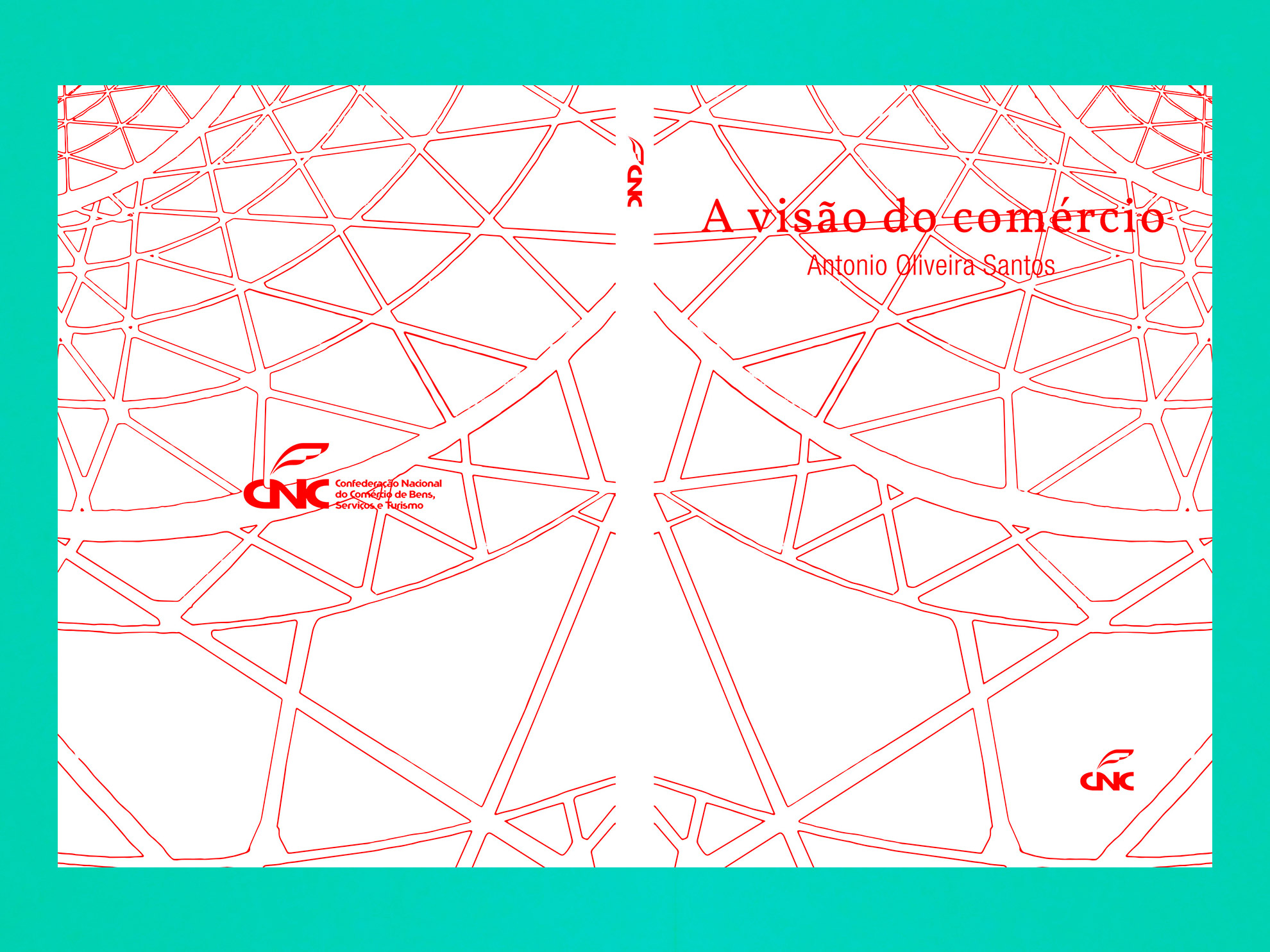
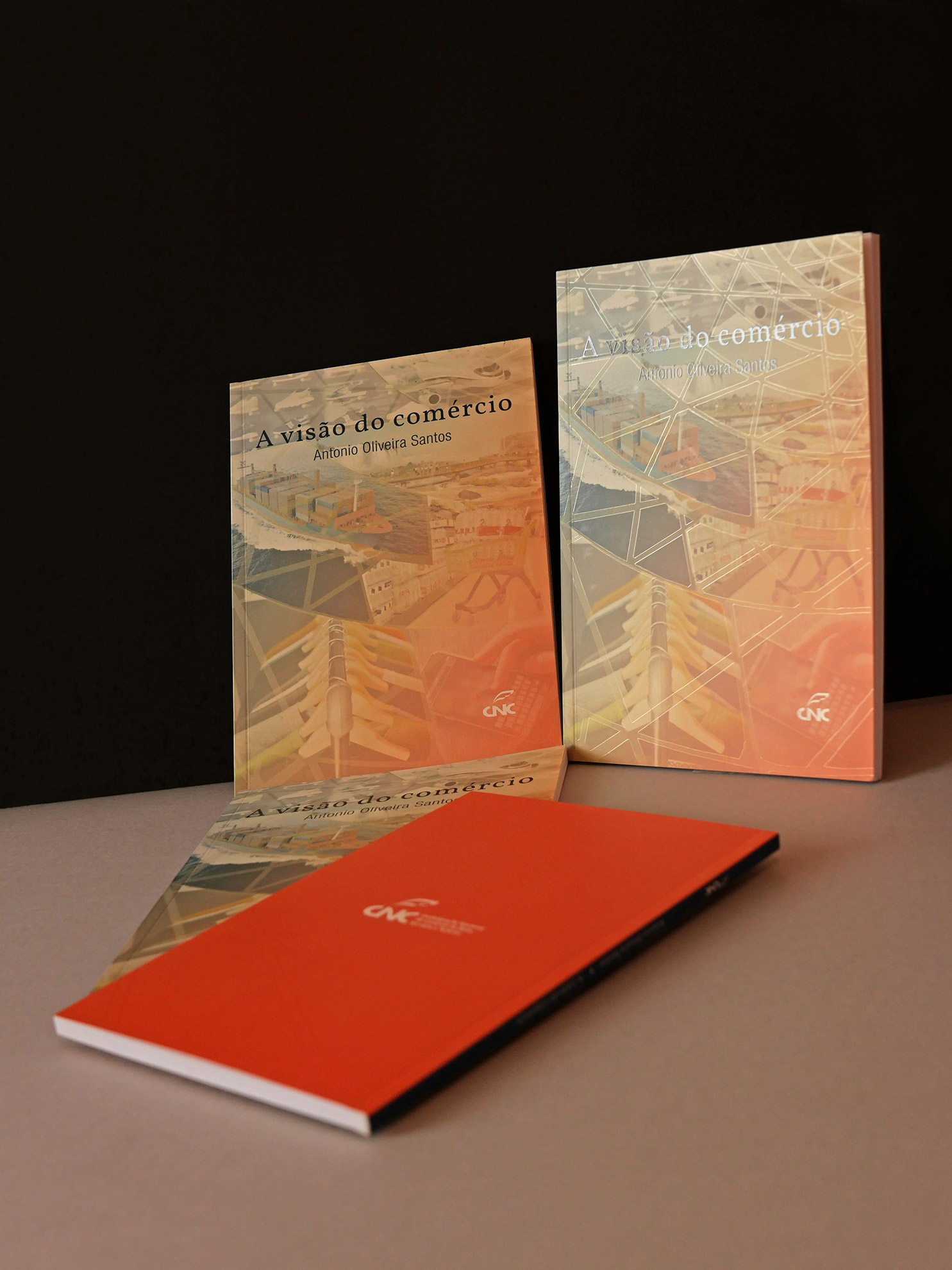
It has given the requirement to follow the publication’s title, “The vision of the commerce”, I have drawn a parallel conceptual line, as I could not take a more concise, conceptual approach, since “The vision of commerce” would necessarily have to be comprehensive; thus, I have been ended up creating a composition of images, it has divided across the sectors of commerce that the CNC represents: Tourism, Retail, Exports, Products, Services, etc. To create interaction between the images whilst dividing them, I have used a texture for aesthetic effect, which also created a dynamic for the cover’s gloss finish. In an effort to give the cover a more institutional feel and make it more ‘corporate’, I have added a gradient effect, as if it were a lens, ranging from orange in the bottom right to a light blue with a high degree of transparency in the top left.
Building on this cover, I have produced three further book designs featuring articles by President Antonio Oliveira Santos: “Emerging from the crisis”, “A new day” and “The time is now – Articles on Tax Reform”, the firsts two are very much in line with this line of reasoning, a self-centred theme, where the president “sets out” on the cover and within the publication the path and direction for the commerce’s sector.
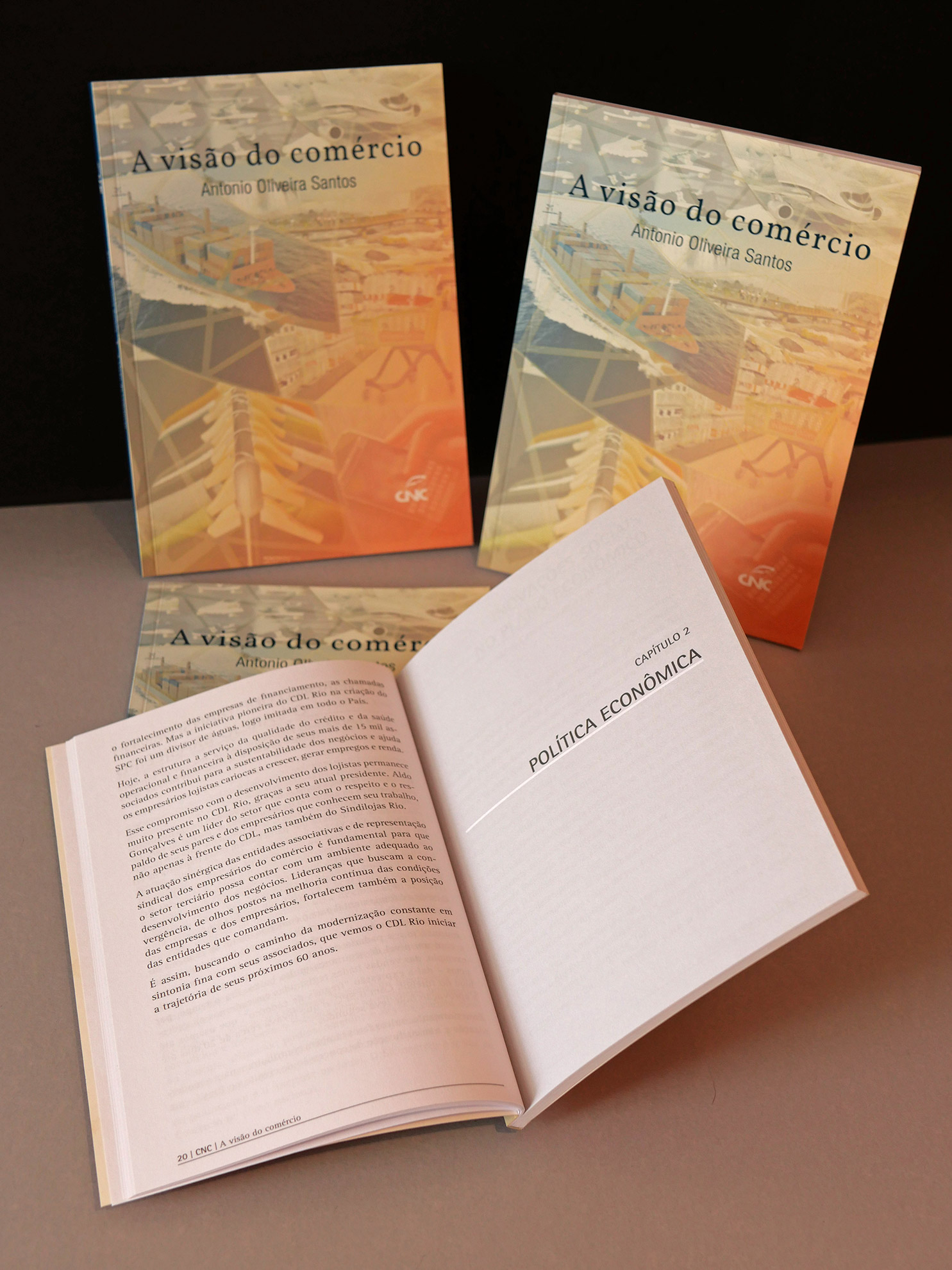
The body of the publication has laid out in such a way as to maintain the seriousness the publication that it has demanded, printed in a single colour and following the organisation of the articles determined for the work.
The book has produced at Gráfica Ultraset in Rio de Janeiro; I have sought to get the most out of the printer in terms of the colours for this project.
1 National Confederation of Trade in Goods, Services and Tourism (CNC – cnc.org.br) – An employers’ trade union organisation, bringing together 34 federations across Brazil, 27 representing their respective states and 7 of these 34 operating at national level, representing over five million businesses in the trade sector that generate around 25.5 million direct and formal jobs. Through its structure, it works to ensure the sector is always involved in the formulation of public policies, monitoring the progress of relevant proposals in the National Congress and defending the Constitution, always keeping a close eye on laws that may impact the sector.
The CNC was founded on 4 September 1945; its president is responsible for the administration of two institutions with significant operations in Brazil, which form one of the largest social development systems in the world: the Social Service of Commerce (SESC – sesc.com.br) and the National Commercial Apprenticeship Service (SENAC – senac.br), the former with social projects such as Mesa Brasil, the Ecos Sustainability Programme, etc. (operating in the following areas: Food, Social Assistance, Culture, Education, Sport, Leisure, Health, Sustainability, etc.) and the latter providing support for the training and upskilling of employees in the commerce sector (shopkeepers, waiters, chefs, hospitality staff, etc.).
2 The words “Order and Progress” are written on the Brazilian flag.

 1
1
 2
2
 3
3