LEONARDO RINALDI
 1
1
 2
2
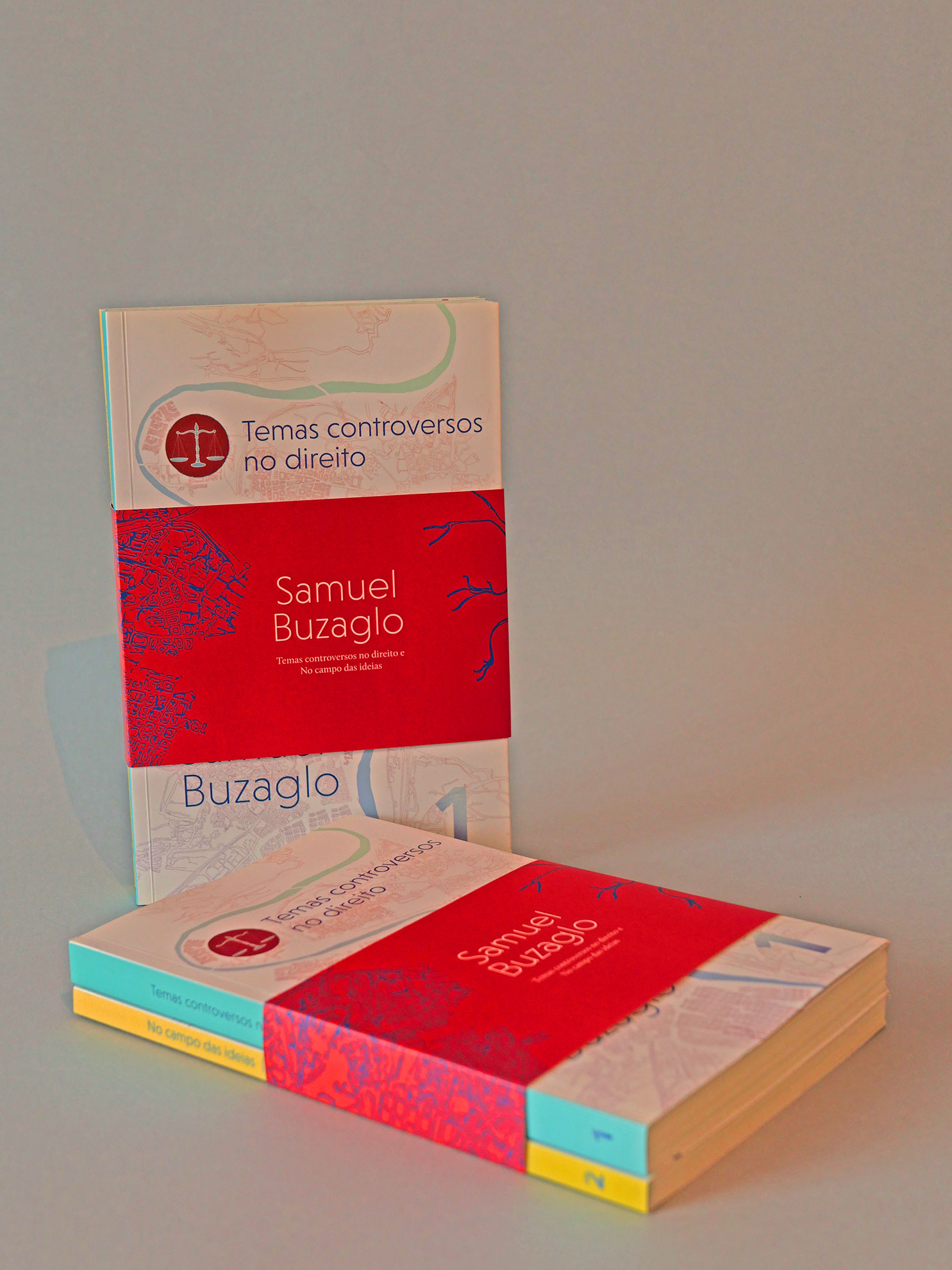
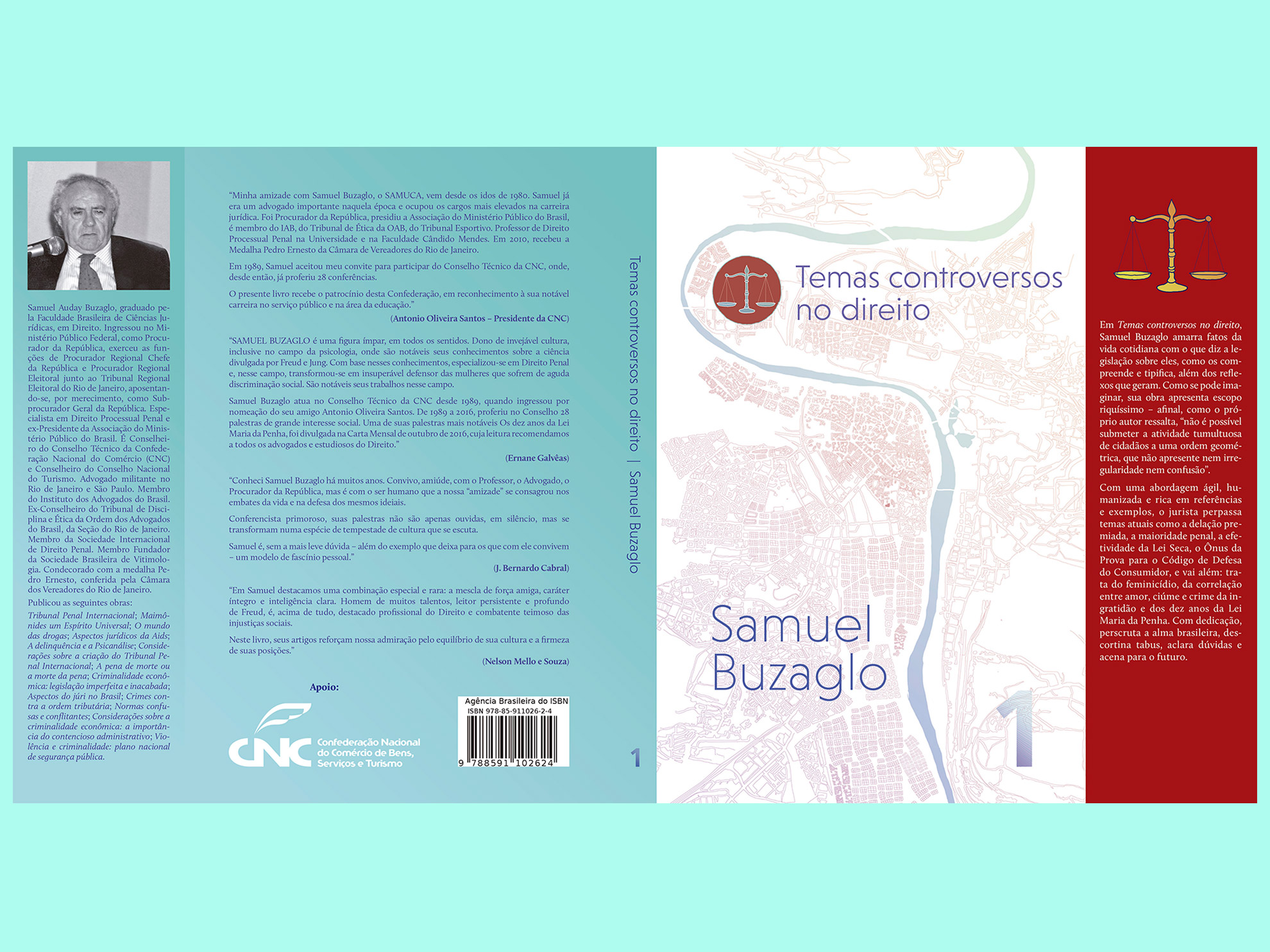
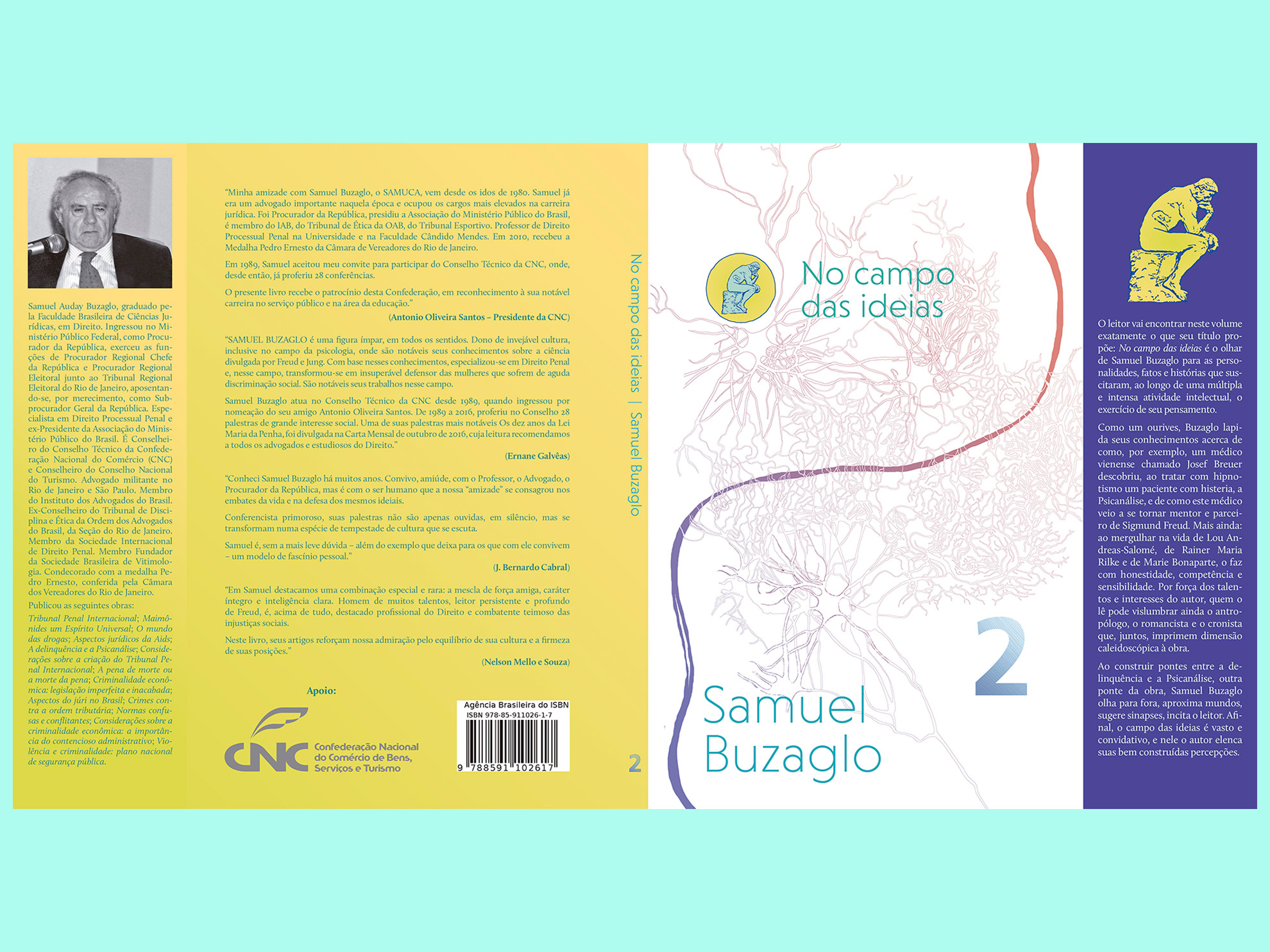
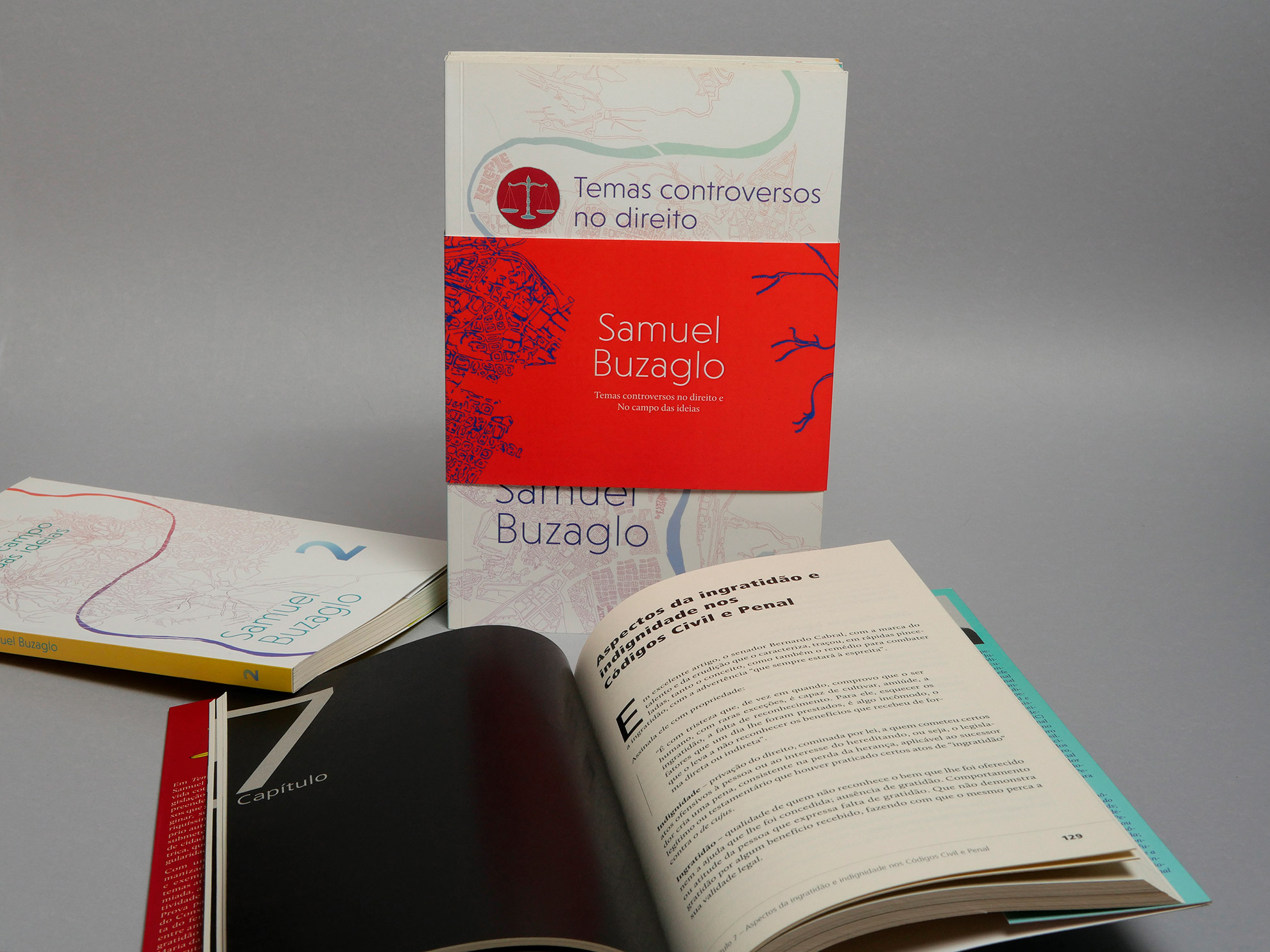
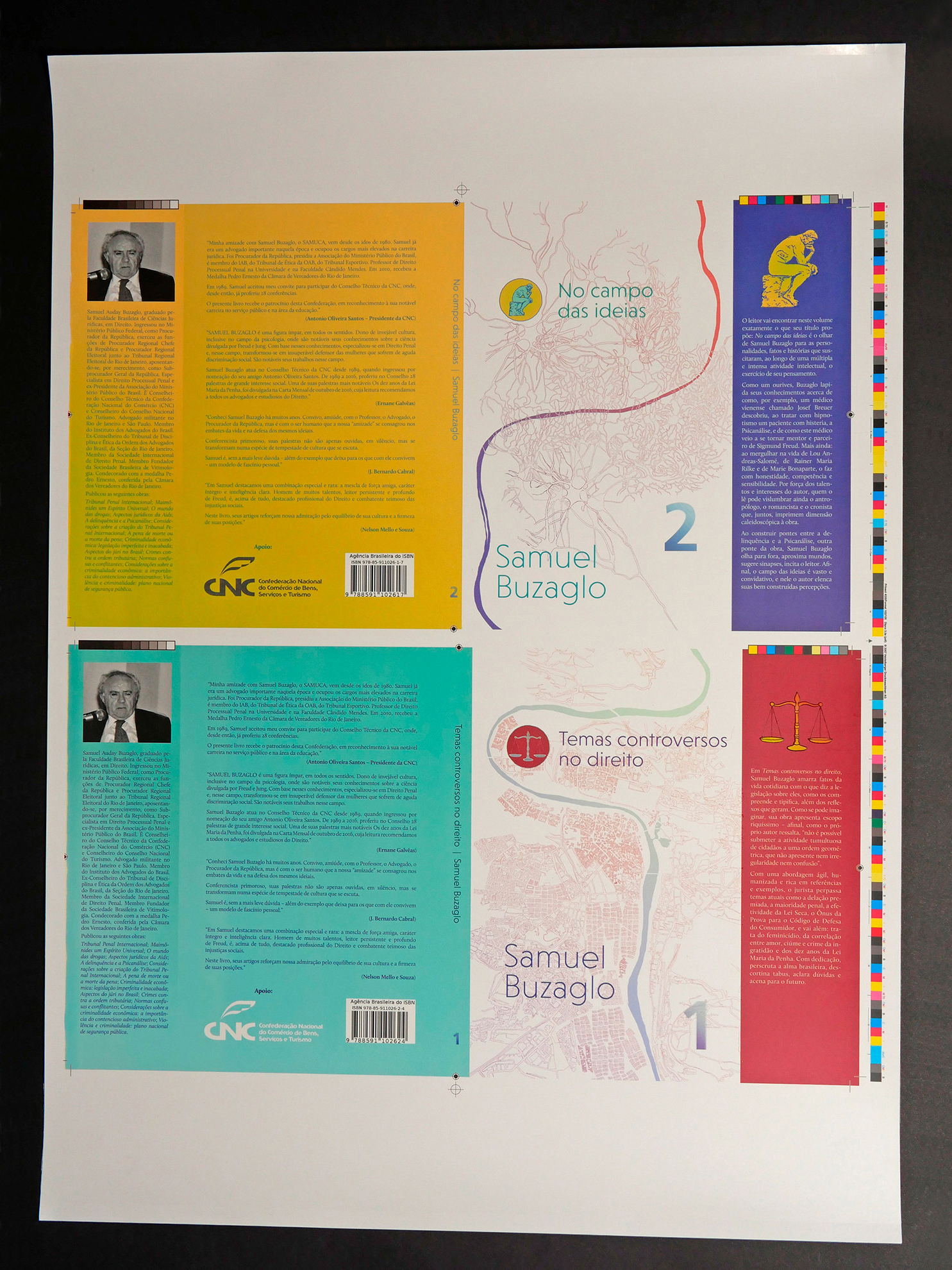
By inverting the ‘convention’, where textures are usually used as supporting elements, in this case they became the main elements of each book. I used a river on the city map in volume one, and as if it were a vein in volume two, to highlight the flow, strengthening the connection between the two volumes. I included the scales icon in the first volume, as I strayed too far from the standard layout of a legal text. For the second volume, I consulted the author’s assistants to choose the other icon together; they suggested ‘Rodin’s Thinker’ (a sculpture by the French sculptor Auguste Rodin). As for the colours, complementary colours were chosen to highlight the contrast between the covers: a swimming-pool blue with a brick red for the first book, and a yellow and a bluish purple for the second, all with subtle gradients. The layout was created using the following typefaces for the interior text: Calluna, size 10.5; Frutiger, sizes 16 and 22. The typefaces for the cover: Niveau Grotesk, sizes 21, 32 and 52; and Frutiger, sizes 72 and 108.
Printing – As the author was covering the cost of printing the books himself, given his limited personal budget, I took even greater care and selected the printers I trusted most in Rio de Janeiro, presenting them to the author. We chose the one offering the best price, which resulted in a low-resolution proof of the entire content and a high-resolution proof of the covers only. For this reason, I had to ensure as far as possible that everything would go smoothly. I oversaw the books being fed into the printing press and also visited the company responsible for the finishing work to check the spot varnishes being applied to the covers.
1 CNC Technical Council – A group where various men and women who had distinguished themselves in their respective fields gave lectures, which were later published as articles; they included diplomats, judges, lawyers, economists, philosophers, etc., among them the Coordinator of the CNC Technical Council and Economic Adviser to the CNC, Ernane Galvêas (former Minister of Finance of Brazil (1980–1985) and former President of the Central Bank of Brazil (1968–1974 and 1979–1980) (IN MEMORIAM)), José Bernardo Cabral (Rapporteur of the 1988 Brazilian Constituent Assembly, former Minister of Justice and former Senator of the Republic), Carlos Tadeu de Freitas Gomes (former Director of the Central Bank), Cid Heraclito de Queiroz (former Attorney-General of the National Treasury from 1979 to 1991), Ives Gandra da Silva Martins (Professor Emeritus at Mackenzie University, UNIP, UNIFEO, UNIFMU, CIEE/O Estado de São Paulo, the Army Command and General Staff Schools (ECEME), the War College (ESG) and the Federal Regional Court of the 1st Region; Honorary Professor at Austral University (Argentina), San Martín de Porres University (Peru) and Vasili Goldis University (Romania); Honorary Doctorate from the Universities of Craiova (Romania) and the PUCs of Paraná and Rio Grande do Sul, and Full Professor at the University of Minho (Portugal); Chairman of the Higher Council of Law at FECOMÉRCIO-SP; Former President of the São Paulo Academy of Letters (APL) and the São Paulo Lawyers’ Institute (IASP), Arnaldo Niskier (Member of the Brazilian Academy of Letters and former President of CIEE/RJ), Vasco Mariz (historian and diplomat, former Brazilian Ambassador to Ecuador, Israel, Cyprus, Peru and Germany), Nelson Mello e Souza (philosopher, former Vice-Chancellor of Estácio de Sá University and member of the Brazilian Academy of Philosophy), Samuel Buzaglo (lawyer, former Deputy Attorney General of the Republic), João Paulo de Almeida Magalhães (economist and researcher at the Centre for Development Studies at CORECON/RJ), Arnaldo Wald (lawyer and Full Professor at UERJ), Marcus Faver (Appellate Judge, former President of the Rio de Janeiro Court of Justice), Claudio Contador (economist, Executive Director of SILCON), Mary Del Priore (historian and writer, member of the São Paulo Academy of Letters), João Ricardo Moderno (journalist), Roberto Fendt (economist, former Special Secretary for Foreign Trade at the Ministry of Economy, Executive Secretary of the Brazil-China Business Council), Maria Beltrão (archaeologist, scientist and researcher, former professor at UERJ, former Director of External Relations at IHGB), Gilberto Paim (journalist) etc.
2 National Confederation of Trade in Goods, Services and Tourism (CNC – cnc.org.br) – An employers’ trade union organisation, bringing together 34 federations across Brazil, 27 representing their respective states and 7 of these 34 operating at national level, representing over five million businesses in the trade sector that generate around 25.5 million direct and formal jobs; through its structure, it works to ensure the sector is always involved in the formulation of public policies, monitoring the progress of relevant proposals in the National Congress and defending the Constitution, always focusing on laws that may impact the sector.
The CNC was founded on 4 September 1945; its president is responsible for the administration of two institutions with significant operations in Brazil, which form one of the largest social development systems in the world: the Social Service of Commerce (SESC – sesc.com.br) and the National Commercial Apprenticeship Service (SENAC – senac.br), the former with social projects such as Mesa Brasil, the Ecos Sustainability Programme, etc. (operating in the following areas: Food, Social Assistance, Culture, Education, Sport, Leisure, Health, Sustainability, etc.) and the latter providing support for the training and upskilling of employees in the commerce sector (shopkeepers, waiters, chefs, hospitality staff, etc.).
Specifications:
Publication titles: Books “Controversial Issues in Law” and “In the Realm of Ideas”
Size (open): 442mm x 230mm *(left flap (60mm) + back cover (150mm) + spine (22mm) + cover (150mm) + right spine (60mm)).
Size (closed): 150mm x 230mm.
Covers
Printing: 4/0 (offset).
Paper: Duo Design 300g/m².
Finish:
Matt lamination (please provide an optional quote for spot varnish).
Square spine, glue and stitching.
Folds: 4 folds (two in the spine area and two more creating the flaps).
Inner pages
Paper: Polén bold 90g/m².
Inner page printing: 1/1 (black).
Printing process: Offset or digital.
Book 1 – Controversial Issues in Law
Number of pages: 268
Print run: X copies
Book 2 – In the Realm of Ideas
Number of pages: 128
Print run: X copies
Proofs
Final proof of the covers (separate quote for this detail).
Final proof of the entire publication.