Summary:
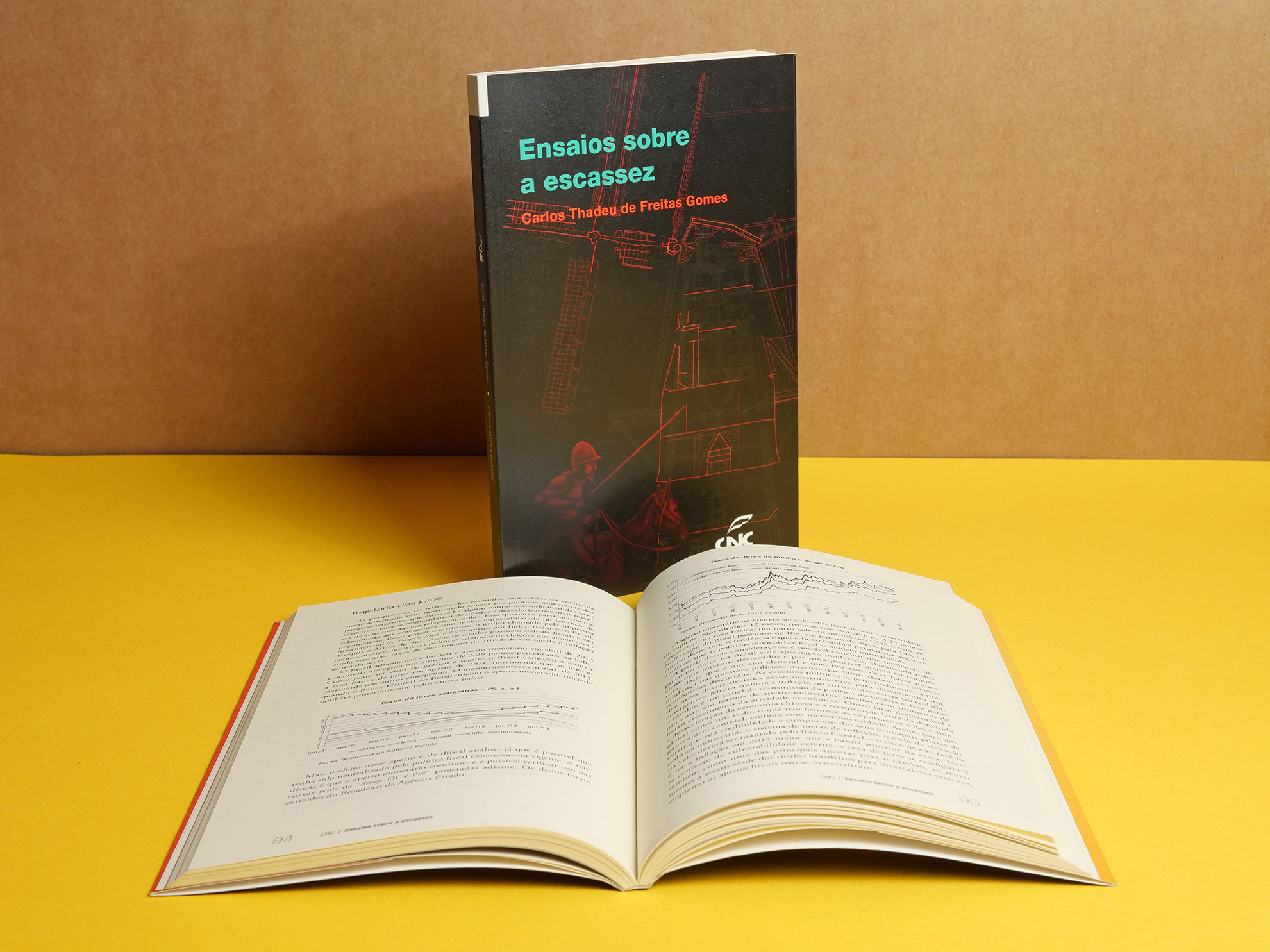
Graphic design for a book – Creation, concept and execution of the entire project, including the layout of the entire book, cover, illustrations and graphic supervision.
The publication is bringing together articles by Carlos Thadeu de Freitas Gomes, a member of the Technical Council1 of the National Confederation of Trade in Goods, Services and Tourism (CNC)2, who was, at the time, Head of the CNC’s Economics Department and a former Director of the Central Bank of Brazil.
This work has created in collaboration with the author. The book is a collection of articles, the vast majority of which have been originally delivered as lectures or presentations and have been subsequently adapted into written articles. Some have taken from magazines and other media where the author’s texts had been published.
Process and concept:
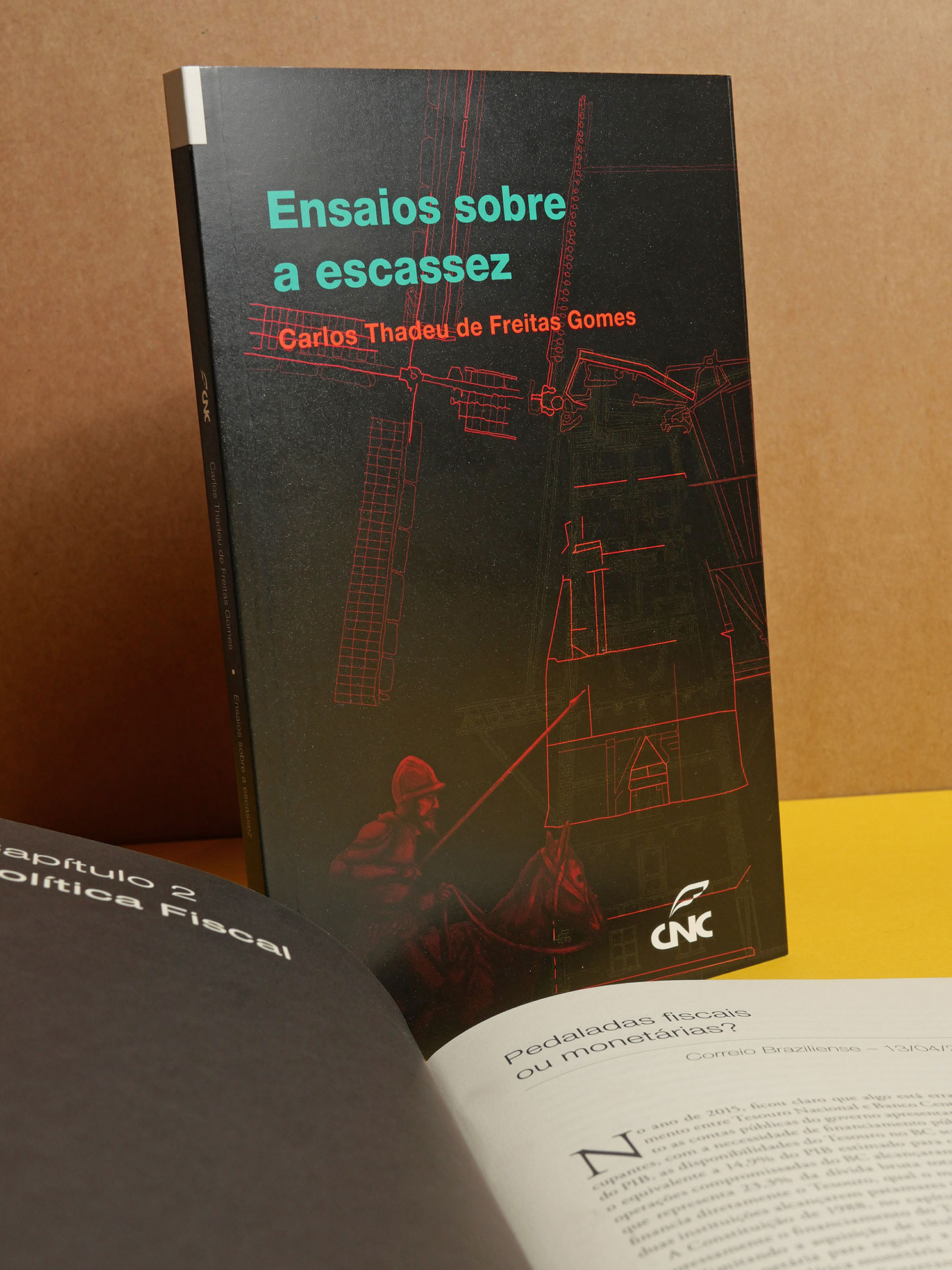
The work has begun at a meeting with Carlos Thadeu de Freitas Gomes, in his office, where we discussed the book’s objectives and possibilities, moving on to its concept. As an economist, he has been a very easy person to work with, we quickly defined what has needed, he has been starting from the initial idea that Economics is a study that addresses scarcity, he has drawn a parallel with Don Quixote, the character from the book bearing his name, by the author Miguel de Cervantes, with his battles against windmills, convoluted equations to transform the reality of calculations into a more abundant environment, the struggle between the physical world, Don Quixote, and the abstract, windmills, where in economics one fights against something intangible, invisible, always is seeking the far-fetched result that can cause immense damage to the stability of a company or a country. I would have liked to have had more space to develop the book’s theme, but I have been limited to the layout of the main body, which is a more metric space, and due to the project’s constraints (restrictive in terms of graphic freedom), I have been left with only the cover, the cover’s varnish, the back cover and the book’s flaps.
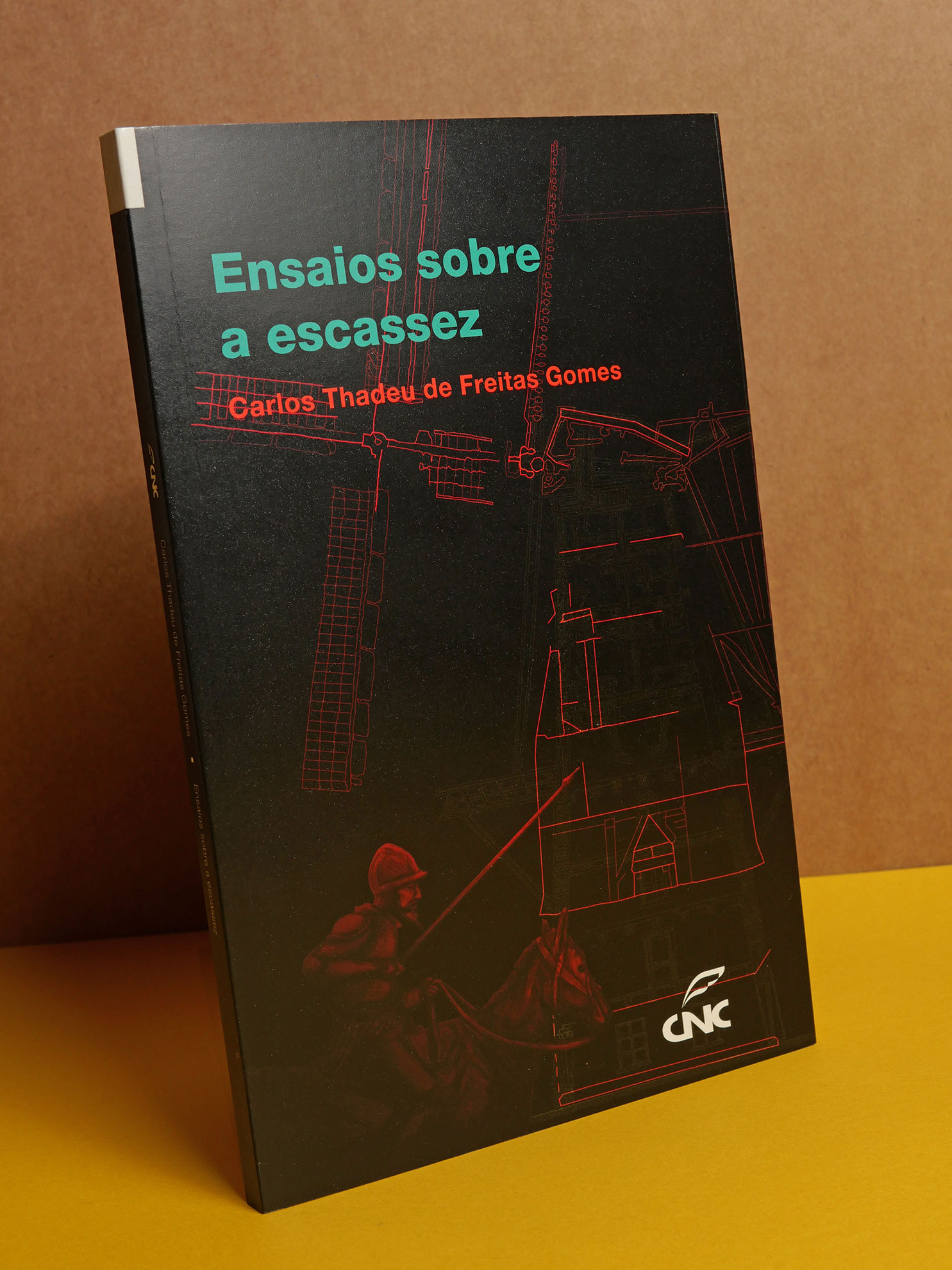
After of I had been laying out all the material, recreating the graphics and sending them for review, I have been studying sketches for the cover. I usually explore the theme of each project in different ways; visiting a bookshop is always one of the key options in this initial phase of research and understanding the subject matter for the approach. It has been at the Cultura bookshop on Senador Dantas Street, in the centre of Rio de Janeiro, that a book has caught my eye for using a different graphic technique. The book was ‘American Gods’ by Neil Gaiman; it had a blue background and a texture, the latter applied using a rough varnish. I had bought the book and I have sent it to one of the best printers in Brazil, Stilgraf, a printing company based in São Paulo, I asked them to analyse the technique, as I had the idea of using this graphic feature in the book; the title contained the word ‘scarcity’, and scarcity is rough. It was the textured varnish that has given a subtle texture, with small bubbles lending roughness to the cover, fulfilling my intention to create a dry, rough and abrasive feel.
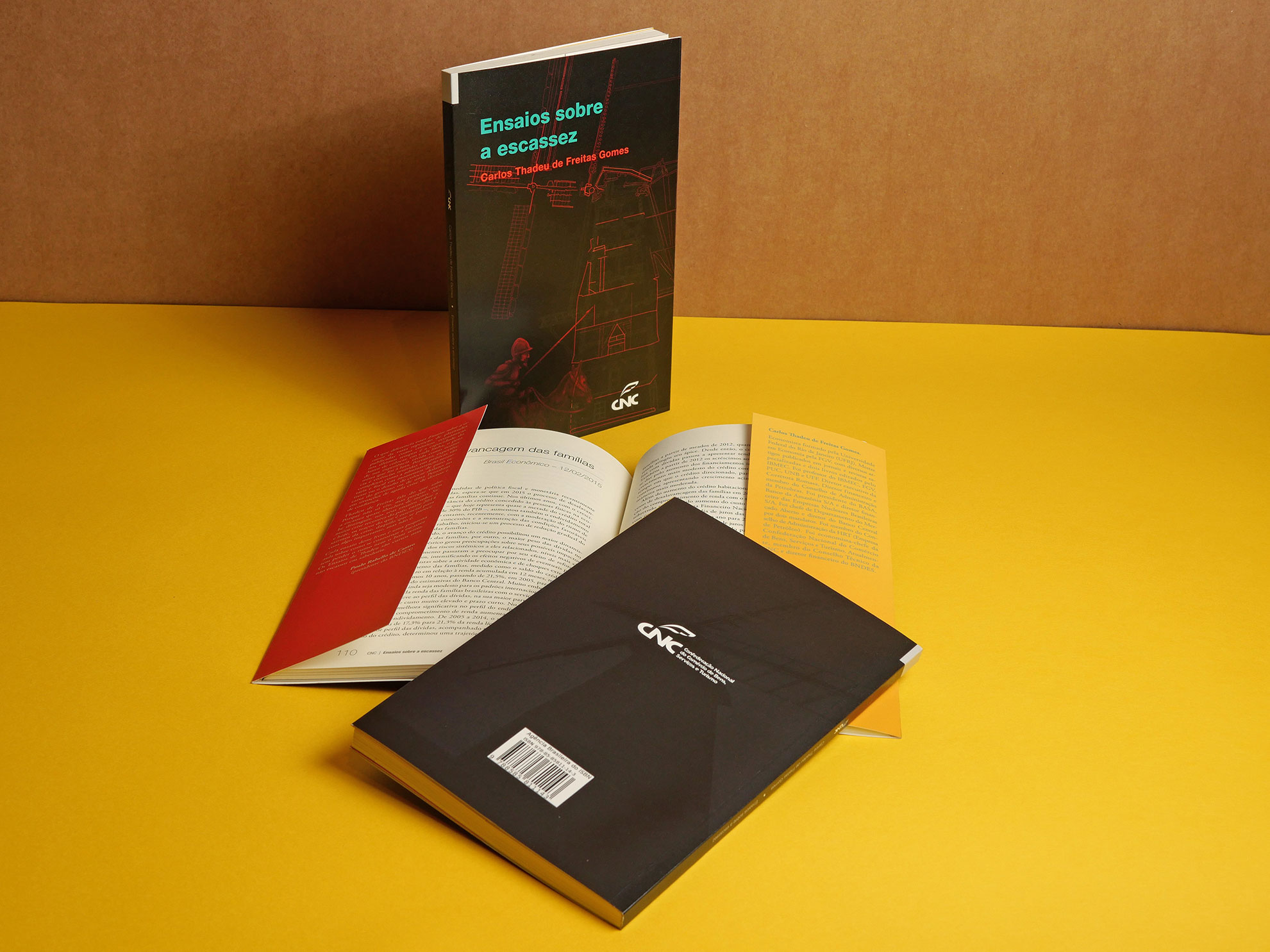
In designing the cover, I have worked with scarcity, and if it has a color at all, that color is black, the ‘nothingness’, the absence of light; I have drawn a Don Quixote, using a reddish hue, somewhat shrouded in darkness, in an attempt to create a more tense atmosphere. And the windmill: I have wanted to make very clear a sense of incompleteness, of a windmill still in the design phase, an unfinished monster, still on paper, something abstract—the human struggle with sub-creations, an economist grappling with something intangible, an enemy not yet fully defined. On the book’s flaps, I have sought to introduce warm colors, colors reminiscent of Cervantes’ Spain, and to use them in a way that complements the black of the cover. On the back cover, I have placed a simple image of a windmill, set well back, just a subtle touch to tie the front and back covers together in very similar tones.
1 CNC Technical Council – A group in which various men and women who have distinguished themselves in their respective fields gave lectures that were later published as articles; they include diplomats, judges, lawyers, economists, philosophers, etc., among them the Coordinator of the CNC Technical Council and Economic Adviser to the CNC, Ernane Galvêas (former Minister of Finance of Brazil (1980–1985) and former President of the Central Bank of Brazil (1968–1974 and 1979–1980) (IN MEMORIAM)), José Bernardo Cabral (Rapporteur of the 1988 Brazilian Constituent Assembly, former Minister of Justice and former Senator of the Republic), Carlos Tadeu de Freitas Gomes (former Director of the Central Bank), Cid Heraclito de Queiroz (former Attorney-General of the National Treasury from 1979 to 1991), Ives Gandra da Silva Martins (Professor Emeritus at Mackenzie University, UNIP, UNIFEO, UNIFMU, CIEE/O Estado de São Paulo, the Army Command and General Staff Schools (ECEME), the War College (ESG) and the Federal Regional Court of the 1st Region; Honorary Professor at Austral University (Argentina), San Martín de Porres University (Peru) and Vasili Goldis University (Romania); Honorary Doctorate from the Universities of Craiova (Romania) and the PUCs of Paraná and Rio Grande do Sul, and Full Professor at the University of Minho (Portugal); Chairman of the Higher Council of Law at FECOMÉRCIO-SP; Former President of the São Paulo Academy of Letters (APL) and the São Paulo Lawyers’ Institute (IASP), Arnaldo Niskier (Member of the Brazilian Academy of Letters and former President of CIEE/RJ), Vasco Mariz (historian and diplomat, former Brazilian Ambassador to Ecuador, Israel, Cyprus, Peru and Germany), Nelson Mello e Souza (philosopher, former Chancellor of Estácio de Sá University and member of the Brazilian Academy of Philosophy), Samuel Buzaglo (lawyer, former Deputy Attorney General of the Republic), João Paulo de Almeida Magalhães (economist and researcher at the Centre for Development Studies at CORECON/RJ), Arnaldo Wald (lawyer and Full Professor at UERJ), Marcus Faver (Appellate Judge, former President of the Rio de Janeiro Court of Justice), Claudio Contador (economist, Executive Director of SILCON), Mary Del Priore (historian and writer, member of the São Paulo Academy of Letters), João Ricardo Moderno (journalist), Roberto Fendt (economist, former Special Secretary for Foreign Trade at the Ministry of Economy, Executive Secretary of the Brazil-China Business Council), Maria Beltrão (archaeologist, scientist and researcher, former professor at UERJ, former Director of External Relations at IHGB), Gilberto Paim (journalist) etc.
2 National Confederation of Trade in Goods, Services and Tourism (CNC – cnc.org.br) – An employers’ trade union organisation, bringing together 34 federations across Brazil, 27 representing their respective states and 7 of these 34 operating at national level, representing over five million businesses in the trade sector that generate around 25.5 million direct and formal jobs; through its structure, it works to ensure the sector is always involved in the formulation of public policies, monitoring the progress of relevant proposals in the National Congress and defending the Constitution, always focusing on laws that may impact the sector.
The CNC was founded on 4 September 1945; its president is responsible for the administration of two institutions with significant operations in Brazil, which form one of the largest social development systems in the world: the Social Service of Commerce (SESC – sesc.com.br) and the National Commercial Apprenticeship Service (SENAC – senac.br), the former with social projects such as Mesa Brasil, the Ecos Sustainability Programme, etc. (operating in the following areas: Food, Social Assistance, Culture, Education, Sport, Leisure, Health, Sustainability, etc.) and the latter providing support for the training and upskilling of employees in the commerce sector (shopkeepers, waiters, chefs, hospitality staff, etc.).

 1
1
 2
2